м. Харків, майдан Конституції, 1,, підʼїзд 4, поверх 7, кімната Nº 47-07 +380 66 078 6292 Пн–Сб: 08:00 – 22:00


Service Information
- Name: Business Plan
Facade works turnkey installation
Turnkey Facade Works in Kharkiv, Kyiv and Across Ukraine
Turnkey facade works are a complete package of engineering and construction services for creating a building’s outer envelope, carried out by a single contractor from the initial technical survey to final handover. This is not merely wall finishing but the formation of a multi-layer system that simultaneously protects the structure from moisture, wind and frost, improves the building’s energy efficiency and shapes its visual appearance. The construction company MikasBud (МікасБуд) performs turnkey facade works in Kharkiv, Kyiv, Dnipro and throughout Ukraine, in compliance with national building codes (DBN), climate loads and the specifics of each site.
A properly built facade works as a single engineering system: insulation, reinforcement, moisture and wind protection, ventilation and decorative finishing. A mistake at even one stage — the wrong insulation, a violated reinforcement technology or incompatible materials — leads to freezing walls, mould, peeling plaster and rising heating costs. That is exactly why facade works must be carried out comprehensively and under expert supervision, rather than as separate, disconnected services.
Quick Answer
Turnkey facade works cover the full cycle: building survey, facade system design, surface preparation, insulation, reinforcement, finishing and quality control. MikasBud operates in Kharkiv, Kyiv, Dnipro and across Ukraine. Indicative pricing — from 800 UAH/m² for the full turnkey package, from 400 UAH/m² for insulation and from 300 UAH/m² for facade repair. Average timelines — from 5 to 14 days, depending on the area and complexity of the site. When the technology is followed, a facade lasts 20–30 years without the need for major repairs.
What Turnkey Facade Works Include
Turnkey facade works are a multi-level process in which each stage is linked to the next and affects the final result. Everything begins with a technical survey of the building. Specialists assess the condition of the walls, the level of heat loss, the presence of cracks, moisture and other defects, and determine the type of base and climate loads. Based on this analysis, the optimal technical solution is developed specifically for your site rather than a template set of works.
The next step is designing the facade system. At this stage the facade type is selected (wet or ventilated), the insulation thickness is calculated, and materials, the reinforcement scheme and the finishing option are defined. Proper design helps avoid cold bridges, condensation inside the structure and premature deterioration of the finish.
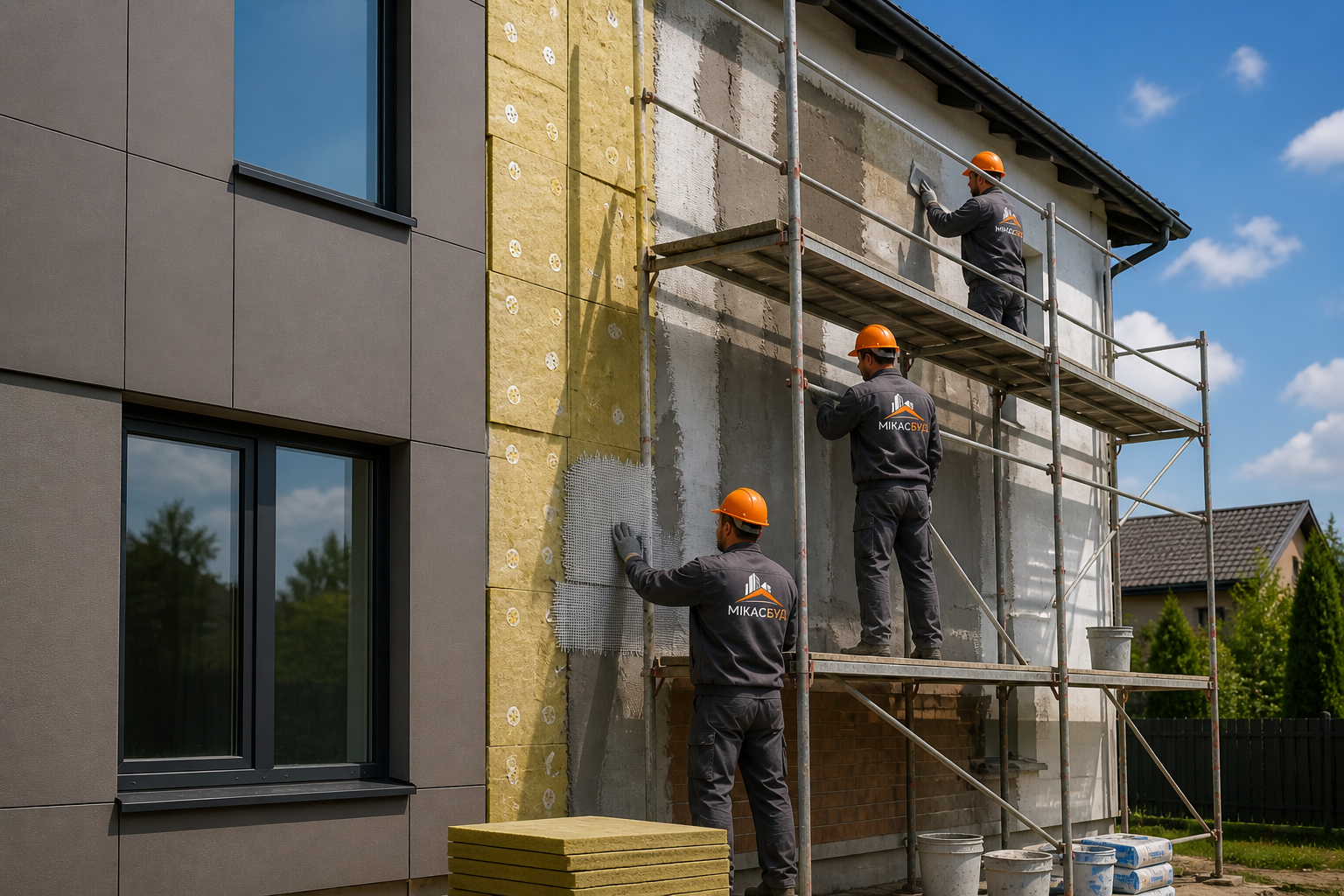
Once the design is approved, surface preparation is carried out: cleaning the walls of old coatings, levelling, repairing cracks and priming. Then the thermal insulation is installed — the foundation of the building’s energy efficiency. A special alkali-resistant mesh is applied over the insulation to prevent cracking, a base layer is applied, and the process is completed with the finish: decorative plaster, painting or panel cladding. Geometry, tightness and compliance with the technology are checked at every stage.
Types of Facade Works
MikasBud performs all the main types of facade works, tailoring the solution to the specific site, budget and operating conditions.
Facade insulation is the core service for reducing heat loss and improving energy efficiency. Quality insulation cuts heating costs, eliminates freezing walls and protects the structure from temperature swings. It is the most in-demand service for private houses and residential complexes in Kharkiv, Kyiv and Dnipro, where thermal insulation is critical in winter.
Wet facade is an insulation system with a plaster finish. The insulation is fixed directly to the wall, reinforced with mesh and covered with decorative plaster. This offers the optimal balance of price, energy efficiency and aesthetics for residential and private buildings.
Ventilated facade is a modern system with cladding panels and a ventilation gap between the insulation and the outer layer. The air gap draws off moisture, extends the service life of the structure and suits commercial buildings, offices and sites with higher durability requirements.
Facade cladding is decorative finishing with various materials: plaster, panels, clinker, stone. It shapes the building’s appearance and provides additional protection for the walls against external influences.
Facade repair covers eliminating cracks, restoring finishes and partial or full restoration of the coating. Repairs are often needed not because of the material itself but because of a previously violated installation technology or incorrect insulation.
Technology and Stages of Execution
Facade works are carried out step by step with strict control at each stage — the sequence is precisely what determines how long the facade will last.
The first stage is analysis. The building is surveyed, problem areas, the level of heat loss and the technical condition of load-bearing structures are identified. For a new build it is important to assess wall evenness and base quality; for older buildings, to detect hidden defects, moisture and areas of deterioration.
The second stage is design. The insulation scheme is developed, mutually compatible materials are selected, the layer thickness is calculated and the installation technology is defined for the specific climate and wall type.
The third stage is implementation. Surface preparation, thermal insulation installation, reinforcement with mesh, application of the base layer and finishing are performed. Special attention is paid to corners, reveals, and junctions with windows and the plinth — these nodes are the most common cause of cracks and leaks.
The fourth stage is control. The quality of the work, geometric precision to within 1–2 mm, the tightness of the nodes and the compliance of all layers with the technology are checked. Control at every stage rules out errors that later lead to facade failure or loss of thermal insulation properties.
Materials for Facade Works
The quality and durability of a facade depend directly on the correct choice of materials and their compatibility with one another. MikasBud uses proven, certified materials that meet DBN requirements.
For insulation, mineral wool and expanded polystyrene (EPS / foam) are used. Mineral wool is a non-combustible material with high vapour permeability, ideal for walls that need to “breathe” and for sites with elevated fire-safety requirements. Expanded polystyrene is a more affordable option with good thermal insulation characteristics, widely used for private housing. The choice of insulation depends on the wall type, budget and operating conditions.
Alkali-resistant reinforcing meshes provide strength to the base layer and prevent cracks from forming during thermal deformation. Decorative plasters (mineral, acrylic, silicone, silicate) create the finished look and protect the facade from rain, ultraviolet light and dirt. The key durability factor is the compatibility of all system components: an incorrect combination of insulation, adhesive, mesh and plaster leads to peeling within just a few seasons. That is why MikasBud works with system solutions rather than individual materials chosen “by eye”.
Facade Insulation and Energy Efficiency
Facade insulation is not only about warmth but about saving money. Through uninsulated walls a building loses up to 30–40% of its heat, and the owner overpays for heating every winter. A quality facade system significantly reduces heat loss, maintains a stable indoor temperature in summer and winter, and pays for itself through lower energy bills.
Beyond savings, proper insulation protects walls from freezing, condensation and mould, extends the service life of the structure and increases the market value of the property. For investors and owners of commercial real estate, an energy-efficient facade means higher liquidity and lower operating costs. For private clients, it means warmth, comfort and no mould on the walls.
Cost of Facade Works
The cost of facade works depends on the area, the type of facade system, the chosen materials, the condition of the building, the height of the site and the complexity of the architecture. Indicative MikasBud prices:
- turnkey facade works — from 800 UAH/m²
- facade insulation — from 400 UAH/m²
- facade repair — from 300 UAH/m²
An exact estimate is drawn up after a site survey and agreement on the technical brief. This approach rules out hidden costs: the client sees the full cost structure in advance and understands what they are paying for. Thanks to precise calculations and well-organised processes, MikasBud delivers budget optimisation of up to 15% and a reduction in timelines of up to 20% compared with the chaotic approach of several separate contractors.
Areas We Serve: Kharkiv, Kyiv, Dnipro and All of Ukraine
MikasBud performs facade works in Kharkiv, Kyiv, Dnipro and throughout Ukraine, adapting the technology to the climate and specifics of each region.
In Kharkiv, it is important to account for temperature swings and humidity — the wrong insulation or a violated technology quickly leads to freezing and condensation. For Kharkiv sites, we pay particular attention to the vapour permeability of the system and thorough protection of the nodes.
In Kyiv, many sites have high building density, limited access for equipment and stricter deadline requirements. For such projects, precise process organisation, work at height and minimising inconvenience for residents and businesses are critical.
In Dnipro and other regions, we take into account the specifics of the buildings, the condition of existing structures and the needs of commercial sites. Working across all of Ukraine allows us to select solutions for the specific climate, wall type and building purpose — from a private house to a multi-storey commercial property.
Who This Service Is For
Turnkey facade works are relevant for a range of clients. Private owners get an insulated home, lower heating costs and an attractive appearance. Developers use facade systems for new builds, residential complexes and cottage settlements, where timelines, scalability and stable quality across large areas matter. Businesses order facades for offices, shops, restaurants and warehouses, where a presentable look and durability are essential. Investors obtain properties with high energy efficiency and liquidity, which reduces future maintenance costs.
Common Mistakes in Facade Works
Understanding common mistakes helps avoid costly rework. The most frequent are:
- lack of a design — work done “by eye” without calculating heat loss or an insulation scheme;
- cutting corners on materials — cheap insulation, thin mesh or poor-quality plaster fail within 1–3 seasons;
- violating installation technology — incorrect fastening, poor reinforcement, ignoring the nodes;
- incorrect insulation — insufficient thickness or the wrong type of insulation, causing freezing;
- lack of quality control — defects accumulate and become visible only after the work is finished.
Each of these mistakes leads to cracks, peeling, mould and heat loss. A comprehensive turnkey approach and control at every stage rule out these risks.
Why Clients Choose MikasBud
The construction company MikasBud takes full responsibility for the result — from the engineer’s first site visit to the final quality inspection. This rules out the risks associated with juggling several different contractors and guarantees stable quality at every stage.
Our track record: over 10 years of experience in construction, more than 100 completed projects of varying complexity, and 90–95% of clients who recommend us after their work is done. We operate transparently: the client receives a clear estimate, a stage-by-stage plan and quality control at every step. All works comply with DBN and come with a warranty. Following the technology ensures the facade lasts 20–30 years without the need for frequent repairs.
How We Work
- Site analysis — engineer’s visit, wall survey, assessment of heat loss and defects.
- Design — selecting the facade system, materials and technology, preparing the estimate.
- Execution — surface preparation, insulation, reinforcement, finishing.
- Quality control — checking geometry, tightness and compliance with the technology.
- Handover — final inspection and delivery of the finished facade with a warranty.
Free consultation • Engineer site visit • Cost estimate in 30 minutes.
Frequently Asked Questions (FAQ)
How much do turnkey facade works cost? Prices start from 800 UAH/m² and depend on the facade type, materials, area and condition of the building. Insulation starts from 400 UAH/m², facade repair from 300 UAH/m². An exact estimate is drawn up after a site survey.
How long do facade works take? On average from 5 to 14 days, depending on the area, building height and complexity of the architecture. Exact timelines are set after the site analysis.
Which insulation is better — mineral wool or expanded polystyrene? Mineral wool is non-combustible and vapour-permeable, suitable for walls that need to “breathe” and for sites with fire-safety requirements. Expanded polystyrene is more affordable and widely used for private housing. The choice depends on the wall type, budget and operating conditions.
What is the difference between a wet facade and a ventilated facade? A wet facade is insulation with a plaster finish fixed to the wall. A ventilated facade has an air gap between the insulation and the cladding panels that draws off moisture and suits commercial properties.
Can only part of the facade be insulated? Yes, individual works are possible, but for energy efficiency it is recommended to insulate the facade comprehensively to avoid cold bridges on uninsulated sections.
Do you provide a warranty on facade works? Yes, all completed works come with a warranty. Its terms depend on the facade type, materials and installation technology.
Do you work across all of Ukraine? Yes, MikasBud performs facade works in Kharkiv, Kyiv, Dnipro and in all regions of Ukraine, accounting for the local climate.
What affects the durability of a facade? The main factors are material quality, their compatibility, adherence to installation technology and control at every stage. When done correctly, a facade lasts 20–30 years.
Is facade insulation mandatory? For energy efficiency, yes. Insulation reduces heat loss by up to 30%, eliminates freezing walls and significantly lowers heating costs.
Can facade works be carried out in winter? Yes, subject to special technologies and temperature regimes, the works are possible in cold weather as well.
Why does a facade crack or peel? The most common causes are the lack of a design, cutting corners on materials, a violated reinforcement technology or incompatible system layers. A comprehensive turnkey approach rules out these risks.
How do I order facade works? Simply leave a request or call us. An engineer will visit the site, carry out a survey, prepare an estimate and propose the optimal solution.
Order Facade Works
The construction company MikasBud (МікасБуд) is a reliable contractor for turnkey facade works in Kharkiv, Kyiv, Dnipro and across Ukraine. Insulation, wet and ventilated facades, cladding and repair — a full cycle with quality control at every stage and a guaranteed result. Contact us for a free consultation, an engineer’s site visit and a cost estimate.